






Video: Inside ATFP Gala 2013
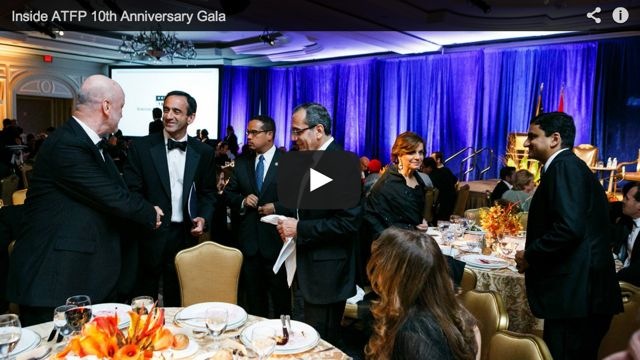
Photo Gallery: ATFP Gala 2013





Media Mention of Ziad Asali in
Voice of America -
June 30, 2009 - 12:00am
http://www.voanews.com/english/2009-06-29-voa32.cfm
TAGS:
http://www.voanews.com/english/2009-06-29-voa32.cfm
In the wake of U.S. President Barack Obama's June 4th speech to the Muslim world and the Israeli prime minister's recent acceptance of a conditional Palestinian state, hopes have risen for a resumption of talks aimed at resolving the long-running Israeli-Palestinian conflict.
The current framework for an independent Palestinian state was first outlined in the 1993 Oslo Accords between Palestinians and Israelis. That agreement described the so-called "two-state solution" - Israel and an independent Palestine living peacefully side-by-side - as the best way to settle the protracted conflict.
Ziad Asali, president of the American Task Force on Palestine, says initial movement toward that solution was stalled by Israeli hard-liner Benjamin Netanyahu during his first term as prime minister from 1996 to 1999. But Asali believes President Obama's recent address in Cairo and other U.S. initiatives have revived interest in the issue by underscoring American support for the two-state solution and calling on Israel to freeze all settlement activities in the occupied territories.
"Settlement freeze means the end of taking lands from the Palestinians and render[ing] the Palestinian state completely impractical. So it is very important that he mentioned it, that [U.S.] congressmen - when Netanyahu came here [to the United States], talked to him about it, and it is important that [Secretary of State] Hillary Clinton talked about it. So it's an important issue, and now it adds credibility to those who advocate the two-state solution."
Asali is hopeful that negotiations might resume soon. But he concedes that the current split between Hamas and the Palestinian Authority are complicating the outlook for the Palestinian half of that two-state solution.
What does two-state solution mean?
And new questions have arisen since Obama's Cairo speech about Israeli interpretations of the two-state concept and the strict conditions set forth recently by Mr. Netanyahu, just re-elected as Israel's prime minister.
Ori Nir, spokesman for Americans for Peace Now, the U.S. branch of Israel's Peace Now movement, says Netanyahu's insistence on maintaining Israeli control of Palestinian air and sea lanes, ruling out the right of return of Palestinian refugees and rejecting U.S. calls to freeze settlements, all threaten progress toward the two-state solution. Nevertheless, Nir believes President Obama can persuade Prime Minister Netanyahu to back up his general acceptance of a Palestinian state with constructive actions.
"I think we have already seen that happening. This administration understands that in order to get some traction on the peace process, it has to lean on both sides, both on Palestinians but also on Israel," Nir says. "We have seen that with settlements. I think the issue of settlements is something that this administration will not give up on, will continue to push for, and I think when it comes to the actual substance of the final status negotiations, this administration will also exercise its authority and put forward its ideas and perhaps even an actual plan of its own."
Israeli-Palestinian conflict key to U.S.-Muslim relations
Nir says momentum toward peace can only be generated if all parties to the conflict take the kind of bold measures for which President Obama is calling. Samer Shehata, a fellow at the Washington-based Woodrow Wilson Center for Scholars, says President Obama clearly understands that peaceful resolution of the Palestinian issue is key to improving relations between the United States and the Muslim world, from Morocco to Malaysia.
"It is clear that President Obama has a very different perspective on the Palestinian-Israeli conflict and the U.S. role than the previous administration. He talked about Palestinian suffering, the daily humiliations of occupation, Palestinian dislocation, and also said that their condition was intolerable, and he talked about Palestine as a state. So this, I think, implies that the U.S. will have renewed efforts and possibly would be more balanced with regard to trying to address the Palestinian-Israeli conflict, possibly put more pressure on Israel."
United States in unique position to bring peace
And it is precisely the close U.S. relationship with Israel that will provide President Obama with the leverage he needs to overcome these obstacles to peace, says Aaron Miller, a public policy scholar at the Woodrow Wilson Center and a former advisor to six secretaries of state on Middle East policy and the Arab-Israeli peace process.
Aaron Miller, a public policy scholar at the Woodrow Wilson Center
"It is because of our intimacy that we are perceived to have leverage; Sadat got it, Arafat got it and King Hussein got it. It is the paradox of the partial mediator that is the secret of the U.S.-Israeli relationship, when we use that relationship wisely. And I would argue to you, since I participated in both Clinton and Bush, that we did not use it wisely. So maybe what Obama is doing is re-injecting some of the balance back."
Miller says he is not discouraged by Israeli Prime Minister Netanyahu's hard-line stance on Palestine. He notes that in the past, many of Israel's most effective peace-makers have been, like Netanyahu, hawkish right-wingers, men such as Menachem Begin and Yitzah Rabin.
Miller expects President Obama will avoid confrontations with the Netanyahu government and will focus instead on his trademark "yes, we can" approach, to convince both sides of the urgent need to reach agreement. The stakes, as always, are high, Miller says: Failure to resolve the Israeli-Palestinian conflict will deepen the region's despair, weaken America's allies, and strengthen the radical forces now working to sow discord in the Middle East.
»


TAGS:
Recent In Print Articles
| Does a Two-State Solution Still Exist? | September 25, 2017 |
| What to do while no peace is in sight | June 22, 2017 |
| Living with a sloping status quo for 50 years | June 8, 2017 |
| Six-Day War: 50th Anniversary with Ziad Asali | June 7, 2017 |
| Fifty Years Since 1967: What Have We Learned about Arab-Israeli Peacemaking? | June 7, 2017 |
| Women in Iraq, Syria need our help | October 14, 2014 |
| ISIS and Sexual Slavery | October 3, 2014 |
| Confronting ISIL: The Day and Decade "After" | September 26, 2014 |
| Iraq’s Kurds reach a fork in the road | September 5, 2014 |
| Al-Omari calls for leveraging Gaza war toward ending Israeli-Palestinian conflict | July 31, 2014 |

Recent News

.@ZiadAsali: By focusing on transition phase, good governance must top agenda to build Palestinian infrastructure
https://t.co/fL2mlkG4Y5
9 years 4 weeks ago
|
In @TheNatlInterest ATFP Pres. @ZiadAsali asks if the two-state solution still exists?
https://t.co/fL2mlkG4Y5
9 years 4 weeks ago
|
RT @Ibishblog: This is sober and correct https://t.co/217oW6j5eC
9 years 5 weeks ago
|
 Front Page Features
American Task Force on Palestine - 1634 Eye St. NW, Suite 725, Washington DC 20006 - Telephone: 202-262-0017